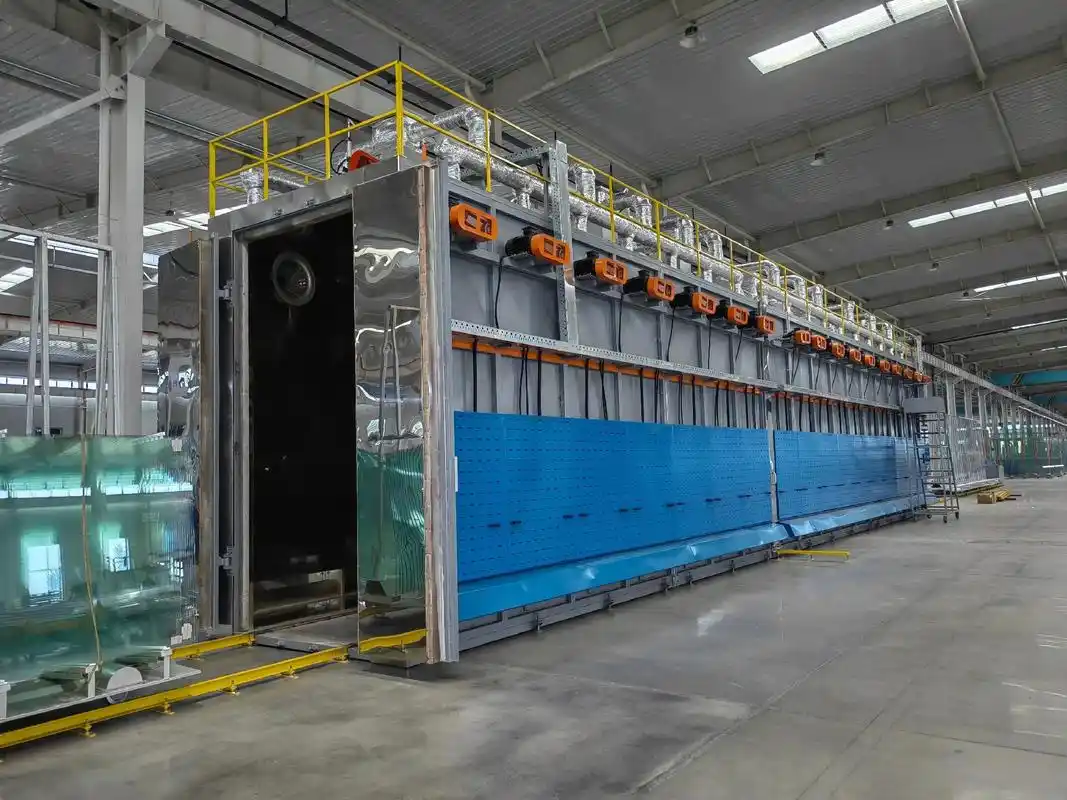
Heat Soak Testing for Critical Tempered Glass Projects
Heat Soak Testing (HST) is an additional quality assurance process performed on tempered glass to reduce the risk of spontaneous breakage caused by nickel sulfide inclusions. It is widely specified for curtain walls, facades, skylights, canopies, high-rise buildings, and safety-critical architectural glass projects.
What Risk Does HST Reduce?
The most common cause of spontaneous tempered glass breakage is microscopic nickel sulfide (NiS) inclusions inside the glass.
Nickel Sulfide Inclusions
Small inclusions may change size over time and create internal stress in tempered glass.
Spontaneous Breakage Risk
Tempered glass can occasionally break without visible impact if critical inclusions are present.
Heat Soak Screening
HST helps identify many problematic panels before installation by exposing them to elevated temperature.
Important: HST Reduces Risk, It Does Not Eliminate It Completely
Heat Soak Testing significantly reduces the risk of spontaneous breakage, but it cannot guarantee complete elimination. It also does not increase the strength of tempered glass. It is an additional quality assurance process for critical applications.
Processing Capabilities
| Specification | Details |
|---|---|
| Applicable Glass | Tempered Glass |
| Standard | EN 14179 |
| Glass Thickness | 4mm – 19mm |
| Maximum Size | Up to 3300 × 13000 mm |
| Safety Glass | ✓ Yes |
| Additional Quality Control | ✓ Yes |
Need-to-Know
| Need | Answer |
|---|---|
| Reduce spontaneous breakage risk? | ✓ Yes |
| Eliminate spontaneous breakage completely? | ✕ No |
| Improve reliability? | ✓ Yes |
| Increase glass strength? | ✕ No |
| Required for some projects? | ✓ Yes |
| Suitable for laminated glass production? | ✓ Yes |
Heat Soak Testing Process
Tempered glass is loaded into a controlled heat soak chamber, heated to elevated temperature, maintained for testing, cooled, and inspected. Panels containing critical inclusions are more likely to break during testing instead of after installation.
Heat Soak Testing Process Flow
HST is performed after tempering and before advanced processing, final inspection, or project delivery.
Heat Soak Tested vs Standard Tempered Glass
Heat soak tested glass offers additional quality assurance for projects where breakage risk and replacement cost matter most.
| Feature | Tempered Glass | Heat Soak Tested Glass |
|---|---|---|
| Safety Glass | ✓ | ✓ |
| Strength | High | High |
| Heat Soak Tested | ✕ | ✓ |
| Risk of Spontaneous Breakage | Standard | Reduced |
| Additional Quality Assurance | ✕ | ✓ |
| Preferred for Critical Projects | Good | Excellent |
When Is Heat Soak Testing Recommended?
HST is commonly specified where glass failure could create safety risks, expensive replacement, or project liability.
Available Glass Configurations
Heat soak testing can be integrated into advanced architectural glass production programs.
Quick Answers
What is Heat Soak Testing?
Heat Soak Testing is a post-tempering process that exposes tempered glass to elevated temperatures to identify panels containing critical nickel sulfide inclusions.
Does HST eliminate spontaneous breakage?
No. It significantly reduces the risk of spontaneous breakage but cannot guarantee complete elimination.
Does HST make glass stronger?
No. HST does not change the strength of tempered glass. It is an additional quality assurance process.